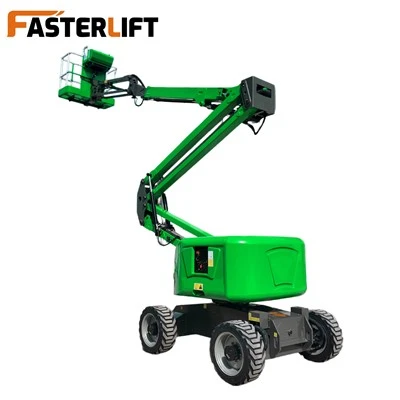
A boom lift (also known as a telescopic or articulated boom lift) is an aerial work platform integrating a self-propelled chassis and a telescopic/folding boom structure. Its core feature lies in the combination of mobility and obstacle-crossing capability, enabling flexible and efficient aerial work.
The main basic features are as follows:
Multi-section boom structure
Articulated boom (folding boom): Employs a multi-stage articulated boom design, which can be folded and stored, unfolding step by step during operation. It has the ability to cross obstacles (such as walls and equipment) and is suitable for cantilever operations in complex environments.
Telescopic boom (straight boom): Uses a straight telescopic boom structure, with a working range of vertical or near-vertical columnar areas. It has a large lifting height and is suitable for high-point operations in open spaces.
360° rotating platform
The work platform and turntable support full rotation, allowing operators to adjust the working direction at any height, improving operational flexibility and precision.
Some models are equipped with an automatic bucket leveling function to ensure the platform remains level during boom luffing.
Self-propelled and Load-bearing Capabilities
Equipped with a fully hydraulic drive chassis, it can move autonomously without external towing, adapting to complex terrains such as factories and construction sites.
Supports load-bearing travel, allowing low-speed movement while the platform is carrying personnel or cargo, enabling "work while moving" and significantly improving multi-point operation efficiency.
Multiple Power Configurations
Diesel Power: Suitable for outdoor and power-free environments, providing strong power and long range.
Battery Power: Zero emissions, low noise, suitable for indoor use, shopping malls, airports, and other locations with high environmental requirements.
Hybrid Power: Combines a diesel generator and a lithium battery, balancing range and environmental friendliness.