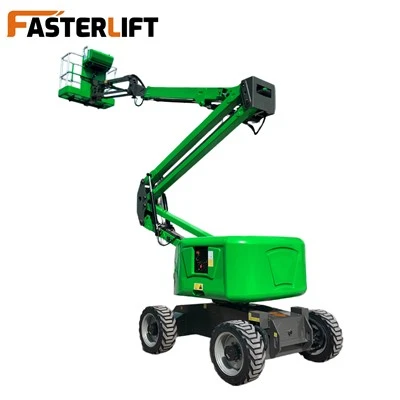
Boom lifts (mainly including articulated boom and folding boom types) are multi-functional equipment used for aerial work. They feature lifting, horizontal extension, and 360-degree rotation, enabling them to overcome obstacles and perform multi-point operations from a single location. They are widely used in municipal, power, advertising, transportation, and construction industries.
Their main functions include:
Aerial Work and Personnel Transport: Safely transports workers and tools to high-altitude work sites, suitable for scenarios such as street light maintenance, building exterior wall construction, and bridge inspection.
Obstacle Crossing: The articulated boom structure can flexibly navigate around walls, trees, equipment, and other obstacles to achieve cantilevered operations, making it particularly suitable for complex terrain or congested areas.
Precise Multi-Angle Positioning: The boom's luffing, extension, and rotation are controlled by a hydraulic system, allowing the work platform to be adjusted to any height, angle, and direction within space, ensuring precise positioning.
Loaded Travel and Mobile Operation: Some models support personnel travel, allowing for work while moving during lifting, improving work efficiency.
Multiple power modes to adapt to different environments:
Electric/Battery driven: Suitable for indoor or environmentally friendly locations;
Diesel powered: Suitable for outdoor environments without power, providing strong power;
Dual power or external power supply: Offers flexibility for both indoor and outdoor use.
Multi-functional expansion interface: Hooks, material platforms, and other devices can be quickly installed via the front bracket, enabling various applications such as lifting and material handling.
High safety design: Equipped with H-type outriggers, an automatic leveling work platform, overload protection, an emergency power source, tilt alarm, and other multiple safety mechanisms to ensure stable operation and personnel safety.