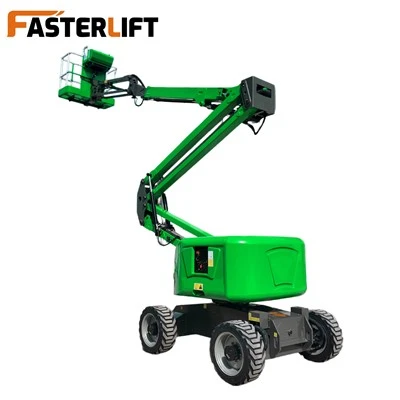
Boom lifts are mainly divided into three types: articulated boom, telescopic boom, and folding boom, with the articulated boom being the most widely used. These devices are all used for high-altitude operations, but their structural designs and applicable scenarios differ, allowing for selection based on actual needs.
1. Articulating Boom Lift
Features: Employs a multi-stage folding boom structure, enabling multi-angle luffing and 360° rotation, flexibly traversing obstacles and completing multiple tasks from a single location.
Advantages: High mobility and flexible steering, suitable for narrow or complex terrain; supports operation while moving, improving efficiency.
Power Types:
Diesel Self-Propelled: Powerful, suitable for outdoor and power-free environments.
Battery Self-Propelled: Zero emissions and low noise, suitable for indoor, shopping mall, and exhibition hall locations with high environmental requirements.
Hybrid Power: Combines the range of diesel and the clean energy advantages of electricity, adaptable to various working conditions.
Structural Classification:
Self-propelled: Equipped with its own chassis, operators can directly control movement and lifting from the platform, resulting in high operational efficiency.
Trailer-mounted: Can be towed by a vehicle, suitable for temporary high-altitude tasks.
Vehicle-mounted: Installed on a truck chassis, facilitating long-distance transport, commonly used for power emergency repairs and communication infrastructure construction.
Spider-type: Tracked chassis with independent outriggers, allowing stable operation on irregular terrain such as mountainous areas and ancient buildings.
2. Telescopic Boom Lift:
Features: Employs a single or multi-section linear telescopic boom, featuring a simple structure, high lifting capacity, and long reach, suitable for vertical or linear high-altitude operations.
Advantages: Working height can reach over 40 meters, with good stability, commonly used in wind power generation, high-rise building exterior wall maintenance, and other scenarios.
Common Configurations: Mostly diesel or hybrid powered, some equipped with insulated booms, suitable for special operations such as power line maintenance.
3. Knuckle Boom Lift
Features: The boom folds in a "Z" shape, resulting in a compact structure. It allows for multi-angle adjustment via a hydraulic system and offers a certain degree of cantilever and horizontal extension capability.
Advantages: Fast deployment, high mobility, suitable for frequent site relocation operations such as municipal works, street lighting, and highway maintenance.
Additional Functions: Optional accessories include a hook, emergency power source, and wireless remote control system, enhancing versatility and safety.