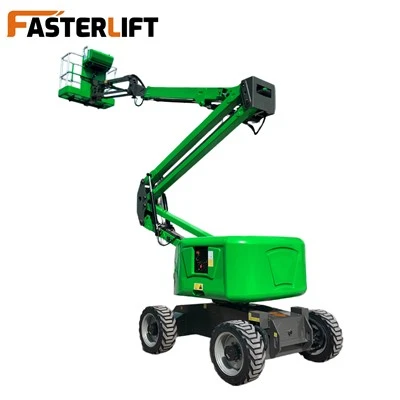
Boom lifts utilize a hydraulic system to drive the extension and luffing of multiple boom sections, enabling lifting, rotation, and obstacle crossing operations. Their core working principle relies on a hydraulic drive system. A hydraulic pump generates pressurized oil, and a control valve group regulates the oil flow, driving the hydraulic cylinders to extend and retract, thereby moving the boom to complete lifting, rotation, and other actions. Operators can precisely control the equipment's operation from the work platform or the ground via an electronic control system. Some models support wireless remote control and dual control systems (valve control + pump control) to improve operational stability and safety.
Detailed Explanation of Boom Lift Working Principle:
Hydraulic Drive Mechanism: Hydraulic oil, pressurized by a vane pump, passes through an oil filter, solenoid directional valve, throttle valve, and balance valve before entering the lower end of the hydraulic cylinder, pushing the piston upwards to raise the platform. During descent, the flow rate is controlled by the balance valve in the return oil circuit to ensure a smooth descent of the load, unaffected by the load itself. A hydraulically controlled check valve (hydraulic lock) automatically locks in case of hydraulic line rupture, preventing accidental falls and ensuring operational safety.
Boom Structure and Movement Methods
Straight Boom: Employs a single or multi-section telescopic boom, simple structure, long reach, suitable for straight-line aerial work.
Articulated Boom: Utilizes a multi-stage folding boom design, allowing for luffing and rotation via hinge points, enabling obstacle crossing, multi-point operation, and 360° rotation.
Knuckle Boom: Compact boom, highly mobile, large working range, commonly used for complex space operations.
Power Source Type
Hydraulic Drive: The mainstream method, smooth operation, high load capacity.
Electric Drive: Uses a motor to drive a chain or wire rope, low noise, suitable for indoor or environmentally friendly locations.
Hybrid Power: Combines a diesel engine and battery system, adaptable to various indoor and outdoor working conditions, improving range and efficiency.
Safety and Intelligent Control System
Equipped with multiple protection mechanisms, including overload alarm, tilt protection, automatic leveling, emergency descent, and anti-pinch device. Some high-end models integrate the T-BOX remote fault diagnosis system, which supports real-time monitoring and historical fault query, improving operation and maintenance efficiency.